EICR Observation Codes Explained: C1, C2, C3, and FI
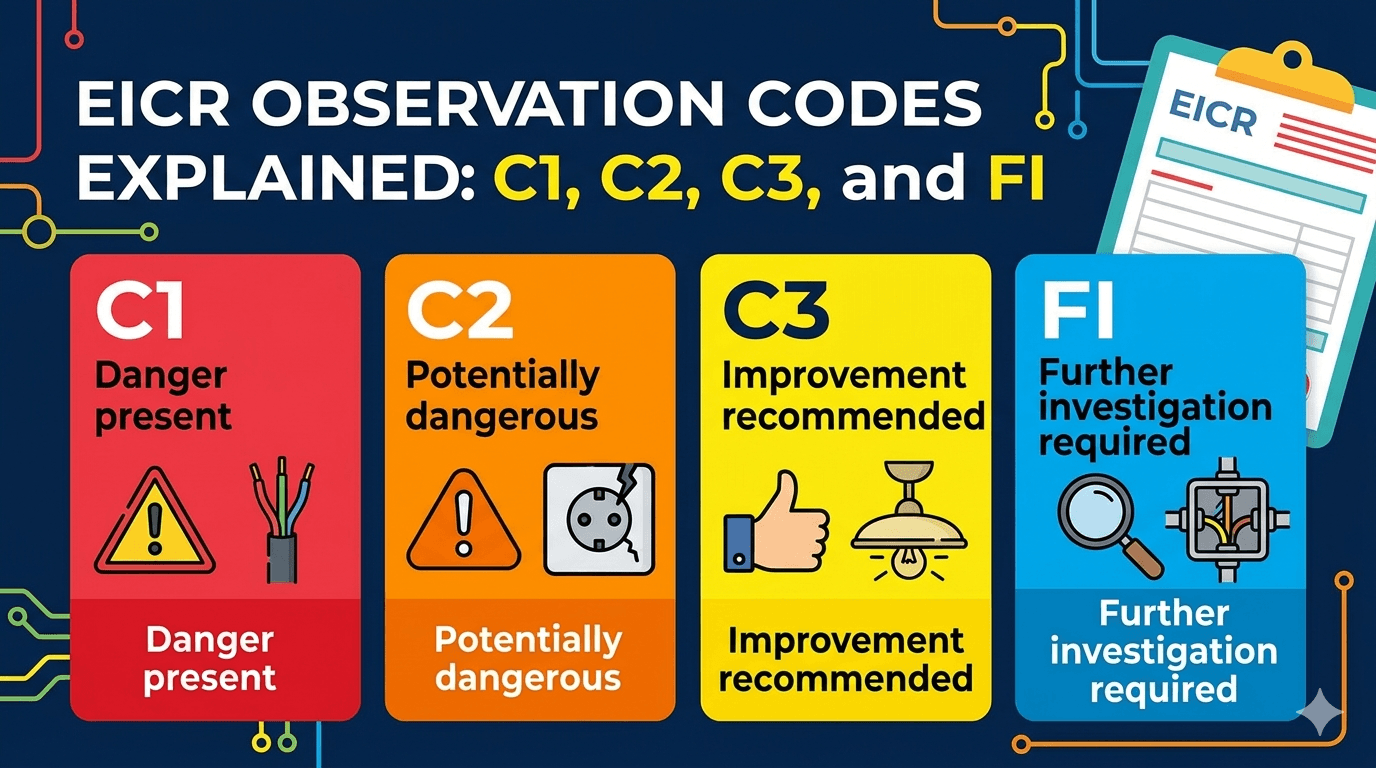
What are EICR observation codes?
When an electrician carries out an Electrical Installation Condition Report (EICR) under BS 7671, every deficiency found gets classified with a code. These codes determine whether the installation passes or fails — and what action the building owner must take.
Getting these codes wrong creates real problems: wrong classification on a report can mean unnecessary remedial work, legal exposure, or — worse — a dangerous installation signed off as satisfactory.
The four classification codes
C1 — Danger present
Risk of injury exists. The installation should be made safe immediately. An EICR with a C1 observation is always classified as Unsatisfactory.
Examples:
- Exposed live parts accessible without tools
- Missing earthing conductor to an appliance
- Burnt-out consumer unit with signs of arcing
What happens next: The electrician may isolate the affected circuit on site. Remedial work is urgent.
C2 — Potentially dangerous
Risk of injury may arise. Urgent remedial action is required. An EICR with a C2 observation is also classified as Unsatisfactory.
Examples:
- Missing RCD protection on socket circuits (post-2008 installations)
- Inadequate bonding to gas/water services
- Insulation resistance below acceptable limits
What happens next: Remedial work should be carried out as soon as possible, but the circuit doesn't necessarily need immediate isolation.
C3 — Improvement recommended
Not compliant with the current edition of BS 7671, but no immediate danger. This does not make the EICR unsatisfactory.
Examples:
- Lack of RCD protection on a pre-2008 installation where it wasn't required at the time
- Consumer unit not to current fire-resistance standard
- Absence of surge protection (now required under Amendment 2)
What happens next: The building owner is advised to consider improvement, but there's no legal obligation to act.
FI — Further investigation advised
The inspector cannot fully assess the condition of part of the installation without further work (e.g., removing covers, testing circuits that were isolated, accessing areas behind fixed furniture).
An FI observation does not make the EICR unsatisfactory on its own, but it means the inspection is incomplete.
What happens next: A separate visit or further investigation is arranged. Once complete, the FI may be reclassified as C1, C2, C3, or cleared.
How codes affect the overall EICR result
| Codes present | Overall result | |---|---| | C3 only | Satisfactory | | FI only | Satisfactory (but incomplete) | | Any C1 or C2 | Unsatisfactory |
A single C1 or C2 observation overrides everything else — the installation fails regardless of how many items pass.
Common mistakes contractors make
- Classifying old but safe installations as C2 — if it was compliant when installed and isn't dangerous now, C3 is correct
- Using C3 for genuine hazards — if there's a real risk of injury, it must be C1 or C2
- Issuing FI and never following up — technically valid, but leaves the report incomplete and the customer exposed
- Forgetting that C1/C2 auto-fail the EICR — no manual override should be possible
How Opscel handles this
Opscel enforces the BS 7671 classification rules at the system level:
- Can't mark an EICR as "Satisfactory" if C1 or C2 observations are present — see how our digital certificates work
- Observations link to remedial quotes — record a C2 on the EICR and the office can open a remedial quote pre-filled with it in one click, using our quotation workflow. Nothing is quoted automatically, so you check the price before it goes out
- Remediation tracking — each observation shows when it has been quoted and can be marked remediated once the work is done
- Zs auto-lookup validates readings against BS 7671 Table 41.4 so borderline values get flagged before the engineer signs off
Separately from the EICR codes, engineers log job defects on-site in the field service app with Opscel's own severities (Observation, Minor, Major, Critical), and the office sees them on the job as soon as they sync. No waiting for paperwork.
Summary
| Code | Severity | EICR outcome | Action required | |---|---|---|---| | C1 | Danger present | Unsatisfactory | Immediate | | C2 | Potentially dangerous | Unsatisfactory | Urgent | | C3 | Improvement recommended | Satisfactory | Advisory | | FI | Further investigation | Satisfactory (incomplete) | Follow-up visit |
Understanding these codes isn't optional — they're the difference between a defensible certificate and a liability.
Want to see how Opscel handles this?
Book a 15-minute demo and we'll walk through it live.
Explore Digital CertificatesKeep reading
EIC vs EICR vs Minor Works: Which Certificate Do You Need?
EIC, EICR or Minor Works? Which electrical certificate to issue for new circuits, consumer unit changes, additions and periodic inspections, job by job.
The RAMS Approval Process: A Guide for UK Contractors
The RAMS approval process for UK fire and electrical contractors: what the law asks, what clients ask, version control, engineer sign-off and approval.

What Is an EICR? A Plain-English Guide for 2026
What is an EICR, who legally needs one, how often, what C1/C2/C3/FI codes mean, and what to do when a report comes back unsatisfactory. A plain-English guide for UK landlords, homeowners, and electrical contractors.