How to Price Electrical Work: A Quoting Guide for UK Electricians

Ask ten electricians what they charge and you'll get ten different answers — and most of them will be guessing at least a little. Pricing is the part of the trade nobody teaches you properly: you learn the electrics, then you're expected to somehow know what a rewire is worth. This guide covers how day rates, hourly rates, and fixed pricing actually work, how to build a rate from your real costs rather than copying a competitor, and how to quote in a way that protects your margin.
Day rate vs hourly rate vs fixed price
Most electrical work gets priced one of three ways, and each suits a different kind of job.
Hourly rate. Best for small, unpredictable jobs — fault-finding, a single socket, a call-out where you genuinely don't know what you'll find until you're on site. The risk with hourly is that customers dislike the uncertainty, and you're not rewarded for being fast.
Day rate. Works well for larger jobs where the scope is roughly known but not down to the last detail — a rewire, a consumer unit swap, multi-day commercial work. You and the customer agree a daily figure upfront, which gives some predictability without forcing you to estimate every last task.
Fixed price. The strongest option for well-defined, repeatable jobs — a consumer unit replacement, a set number of socket installs, an EV charger fit. The customer gets total certainty on cost, and because you already know roughly how long the job takes, you get better pounds-per-hour than if you'd charged hourly and worked efficiently. Most domestic customers prefer fixed pricing when it's available, because it removes the fear of an open-ended bill.
A common and sensible pattern: quote fixed for known, repeatable work; use day rates for larger jobs with some scope uncertainty; use hourly plus a call-out fee for reactive and diagnostic work.
What UK electricians actually charge
There's no single "correct" rate — figures vary significantly by source, region, and how the job is scoped, and you'll find real spread even within the same city. As a general picture for 2026:
- Self-employed hourly rates for standard domestic work commonly sit in the region of £45–£65, with London and the South East running higher — sometimes £80+.
- Day rates for domestic work typically fall somewhere between roughly £220 and £400, with commercial and specialist work (EV charging, solar PV, testing and inspection) at the upper end and beyond.
- Employed electricians on JIB national agreed rates are on a different scale entirely — those are wage benchmarks for employment, not a guide for self-employed pricing.
- Materials are charged on top of labour, typically with a 10–20% markup to cover sourcing, handling, and the working capital tied up before you're paid.
Take any single "average" you read online — including the ranges above — as a rough steer, not a target. The number that actually matters is the one you calculate from your own costs, which is the next section.
Build your rate from your costs, not from guessing
The most reliable way to set a rate isn't to ask what everyone else charges — it's to work backwards from what you need to earn and what it costs you to trade. The logic looks roughly like this:
- Start with your target income — what you actually want to take home in a year.
- Add your business costs — van, tools, insurance, testing equipment, certification and CPD, software, accountancy, marketing.
- Add employer-equivalent costs if relevant — National Insurance, pension contributions, holiday and sick pay you're effectively self-funding.
- Divide by your realistic billable days — not 365, and not even 5-day weeks all year. Account for admin time, quoting, travel between jobs, illness, and slow periods. Most tradespeople land somewhere around 180–220 genuinely billable days a year once that's accounted for.
- Add a profit margin on top — this is a business, not a wage; a margin of 10–20% over your break-even day rate is a reasonable starting point.
Worked example: if your target income plus business costs plus employer-equivalent costs comes to roughly £70,000, and you have 210 billable days, that's about £333 a day just to break even — before profit. Add 15% and you're closer to £385. If you're charging materially less than the number this calculation produces, you're not pricing yourself out of the market — you're underpaying yourself.
Track your actual profitability, job by job
Rate-setting isn't a one-off exercise. The most useful habit in the trade is tracking how long jobs actually take against what you charged for them, so you can see your effective hourly rate per job type — not your quoted rate, your real one.
A concrete example: if a consumer unit replacement takes four hours and you charged £600 fixed, your effective rate is £150/hour — likely far better than if you'd quoted the same job hourly. Do this consistently across job types and you'll quickly see which work is genuinely profitable and which is quietly costing you money once your real time is accounted for. Jobs that look fine on paper — a "quick" fault-find that always somehow takes three hours — are usually the ones dragging your average down.
Common pricing mistakes
Quoting from memory instead of a survey. For anything beyond a small job, seeing the site before fixing a price avoids the classic trap of underestimating access, condition, or scope — older wiring, tight lofts, and awkward access all add real time that a phone-based estimate misses.
Not accounting for materials price movement. Material costs have moved significantly in recent years, and pricing from an old mental benchmark ("consumer units are about X") rather than a current supplier price is a fast way to erode margin on exactly the jobs you thought were safe fixed-price bets.
Charging the same rate for every job type. Testing and certification work carries different liability from installation work — you're putting your name and registration behind a signed-off assessment. Specialist work (EV charging, solar PV, fire alarm, emergency lighting) commands a premium because of the additional qualification and risk. Charging one flat rate across all of it under-prices your specialist work and over-prices your simplest jobs.
No minimum call-out charge. Without one, a five-minute fix costs you a wasted journey. A minimum charge for the first hour (commonly in the region of £80–£120) protects against jobs that aren't worth the trip otherwise.
Never revisiting your rate. Rates set two or three years ago, before recent cost increases, are quietly losing you money every job. Revisit your calculation at least annually.
What should a written quote include?
Whatever pricing model you use, a proper written quote — not a verbal figure — protects both you and the customer:
- Clear scope: exactly what work is included (and what isn't)
- Whether the price is fixed, day rate, or hourly-plus-materials
- Materials: included or charged separately, and any markup basis
- Whether certification (EICR, Minor Works, Building Regs notification) is included
- Payment terms and any deposit required
- How long the quote is valid for, given materials can move in price
Turning your pricing into faster quotes
Getting the rate right is only half the problem — the other half is turning it into a professional quote quickly enough that you're not losing evenings to admin, and consistently enough that you're not accidentally under-quoting a job type you priced correctly last time but forgot the details of this time.
That's the gap Opscel's quoting tools close: build your rates and common job templates once, generate a professional itemised quote on site in minutes, and every quote pulls from the same pricing logic so nothing drifts between jobs. See how Opscel's electrical quote software turns your pricing structure into consistent quotes without redoing the maths every time.
Pricing figures in this guide are indicative ranges drawn from industry surveys and vary by region, job type, and market conditions. Always calculate your own rate from your actual costs rather than relying on published averages alone.
Want to see how Opscel handles this?
Book a 15-minute demo and we'll walk through it live.
Explore Quotes & EstimatesKeep reading
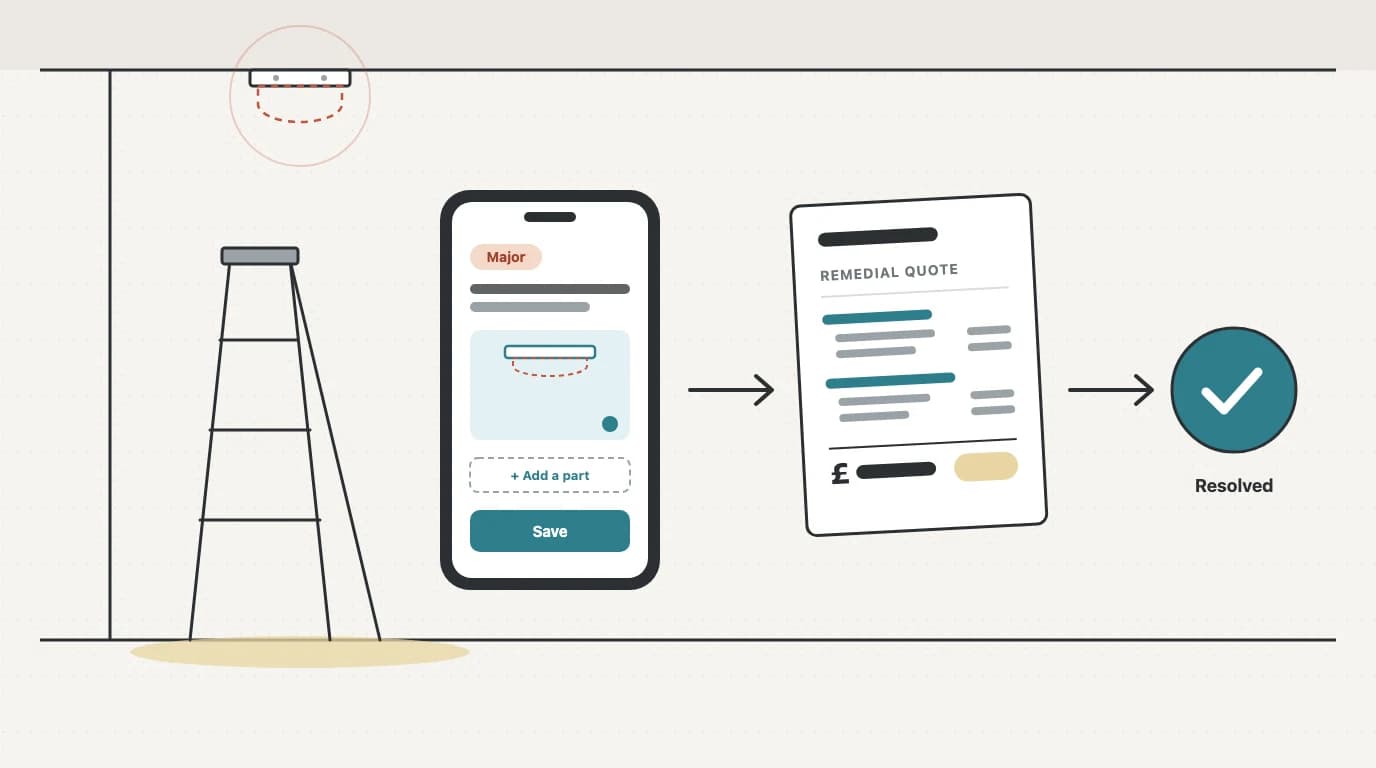
From Defect to Remedial Quote: A Workflow for Fire Alarm Contractors
Faults found on a service visit are remedial work waiting to be quoted. A practical workflow for fire alarm contractors: capture defects properly on site, triage by severity, bundle them into one quote, and track each one to resolution.

PAT Testing Requirements UK: The Complete 2026 Guide
Is PAT testing a legal requirement in the UK? What the Electricity at Work Regulations actually say, how often to test by risk category, who needs it, and what changes for social landlords in 2026.

What Is an EICR? A Plain-English Guide for 2026
What is an EICR, who legally needs one, how often, what C1/C2/C3/FI codes mean, and what to do when a report comes back unsatisfactory. A plain-English guide for UK landlords, homeowners, and electrical contractors.