What Is an EICR? A Plain-English Guide for 2026

If you own, let, or manage a property in the UK, sooner or later someone will ask you for an EICR. It sounds like jargon, and the report itself is dense with codes and clause numbers — but the idea behind it is simple. This guide explains what an EICR is, who legally needs one, how often, what the pass/fail codes actually mean, and what to do when a report comes back unsatisfactory.
EICR meaning: what the letters stand for
EICR stands for Electrical Installation Condition Report. It's a formal document produced by a qualified electrician after they've inspected and tested the fixed electrical installation in a property — the wiring, the consumer unit (fuse box), sockets, switches, light fittings, and anything else permanently wired in.
In plain terms, an EICR is an MOT for your building's electrics. The electrician checks the installation against the current UK wiring standard, BS 7671 (the IET Wiring Regulations), grades anything they find, and tells you whether the installation is satisfactory or unsatisfactory — safe to keep using, or in need of remedial work.
You may hear it called an "electrical safety certificate," a "landlord electrical certificate," or by its old name, the Periodic Inspection Report (PIR). They all point to the same thing. The EICR replaced the PIR and is now the standard report across the industry.
2026 update: The wiring standard moved to BS 7671:2018+A4:2026 — known as the "Orange Book" — which became current on 15 April 2026. There's a transition period until 15 October 2026; after that date, any new EICR must be assessed against the A4 amendment. If you're commissioning a report in late 2026, it's worth confirming your electrician is working to A4.
What an EICR does and doesn't cover
An EICR covers the fixed installation only. That means:
- Consumer units / fuse boards
- Fixed wiring and circuits
- Sockets, switches, and isolators
- Light fittings and fixed lighting
- Permanently connected equipment (e.g. electric showers, hardwired appliances)
It does not cover portable appliances — anything that plugs into a socket, like kettles, fridges, washing machines, or office equipment. Those are the domain of PAT (Portable Appliance Testing), which is a separate process with its own rules. People often assume one covers the other; it doesn't.
Who needs an EICR, and how often?
This is where it stops being optional for a lot of people.
Private landlords (England)
If you let residential property in England, an EICR is a legal requirement. Under the Electrical Safety Standards in the Private Rented Sector (England) Regulations 2020, you must:
- Have the fixed installation inspected and tested at least every 5 years by a qualified person
- Provide a copy of the report to tenants (before a new tenancy begins, and to existing tenants on request)
- Complete any required remedial work within 28 days (or sooner if the report specifies)
The penalty for non-compliance is steep — local authorities can issue fines of up to £30,000 per breach. A practical point that catches landlords out: those first reports done in 2021, when the rules hit existing tenancies, are now reaching the end of their five-year validity. If yours dates from 2021, it's due.
Scotland, Wales, and Northern Ireland have their own broadly similar requirements rather than being covered by the England regulations — if you let outside England, check the rules for your nation.
Social landlords
Electrical safety obligations are being extended to the social rented sector from May 2026. If you manage social housing, the direction of travel is clear: the same inspect-and-certify discipline private landlords already follow now applies to you, so it's worth getting ahead of renewal scheduling rather than reacting to deadlines.
Homeowners
There's no law forcing owner-occupiers to get an EICR, but the long-standing recommendation is an inspection every 10 years, or at change of occupancy (i.e. when you buy or sell). Many buyers now ask for one as part of due diligence, and insurers may ask about the condition of the electrics after a claim.
Commercial and business premises
For most commercial properties the recommended interval is every 5 years, though it varies by installation type and how demanding the environment is — industrial units, premises open to the public, and high-risk settings may warrant more frequent inspection. The responsible person under health-and-safety duties is expected to keep the installation maintained, and an EICR is the standard evidence that you have.
Understanding the codes: C1, C2, C3 and FI
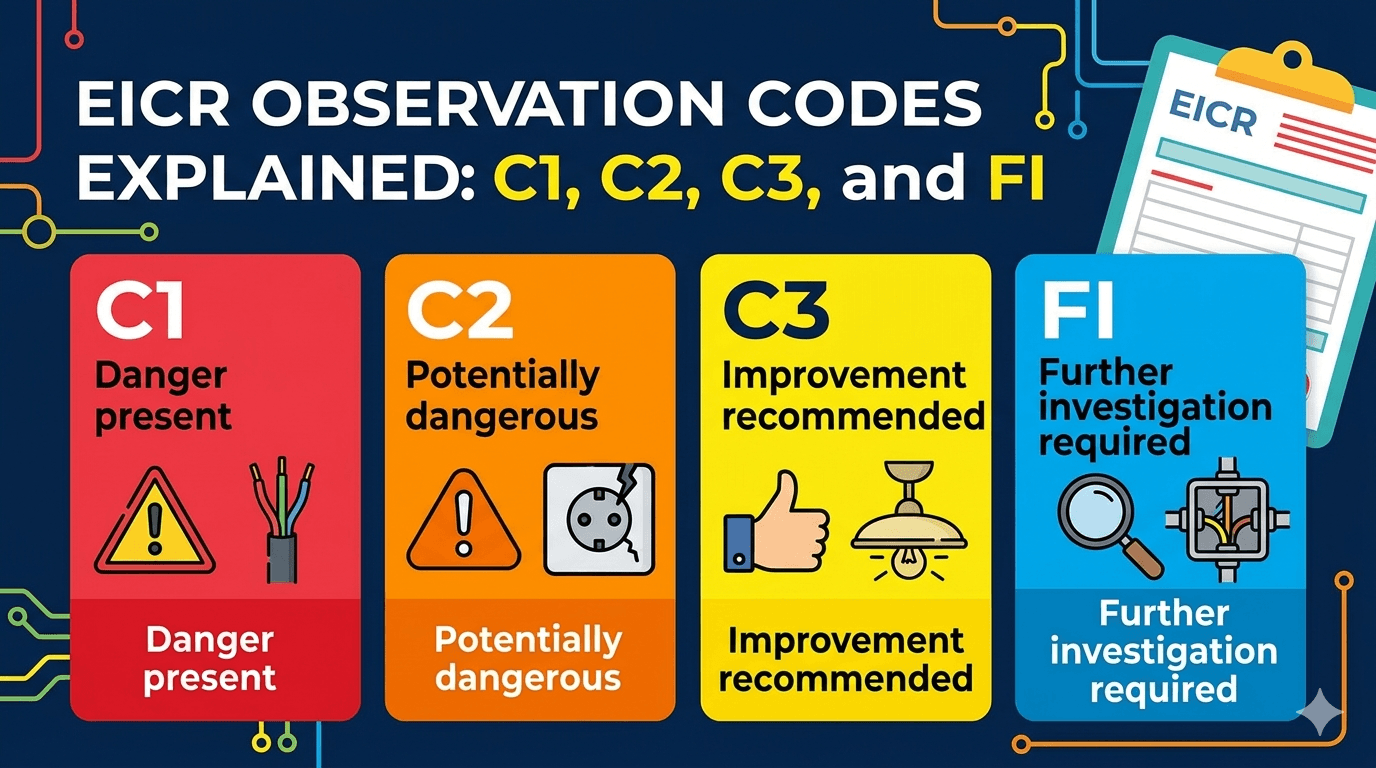
The part of an EICR that confuses people most is the observation codes. Every issue the electrician records gets a classification, and the codes determine whether the whole report passes or fails.
- C1 — Danger present. A risk of injury exists right now. This requires immediate action; the electrician will usually make it safe on the spot.
- C2 — Potentially dangerous. Not an immediate threat, but it could become one. Urgent remedial work is needed.
- C3 — Improvement recommended. Not dangerous and not a failure on its own — a recommendation to bring the installation up to current best practice.
- FI — Further investigation. The inspector found something that can't be fully assessed without more work. Under A4 the code reads "further investigation is advised", and it should still be followed up promptly.
The rule for the overall result is straightforward:
- Any C1 or C2 = Unsatisfactory. Remedial work is needed before the installation is considered safe.
- C3 or FI observations only = the report is still Satisfactory. Under BS 7671:2018+A4:2026, C3 and FI are advisory. You don't have to act on C3s, though addressing them is good practice. Landlords in England must still have FI items investigated within 28 days.
So a report can list several findings and still pass — what matters is whether any of them are C1 or C2. Reports issued before 15 October 2026 may have followed the older guidance, which treated FI as unsatisfactory too.
What happens if an EICR is "unsatisfactory"?
An unsatisfactory result isn't a disaster, but it does start a clock. The faults flagged as C1 or C2 need to be put right by a qualified electrician, any FI items investigated, and the installation re-checked. For landlords, that work must be completed within 28 days (or the shorter period the report states), with written confirmation that the remedial work has brought the installation up to standard. Only once a satisfactory report is in place does the next five-year cycle begin.
If your previous certificate has already expired, the sensible move is to book an inspection straight away and keep a record of the booking as evidence you're acting — local authorities have been actively enforcing, and a lapsed certificate can also complicate possession proceedings.
How long does an EICR take?
It depends on the size and complexity of the installation, mainly the number of circuits. As a rough guide:
- A small flat or one-bed property: around 1–2 hours
- A typical 3-bed house: around 2–4 hours
- Larger homes, HMOs, and commercial premises: longer, sometimes spread across a visit or two
Because circuits are tested individually and power needs to be turned off to parts of the installation during testing, it's worth telling occupants in advance so access and downtime can be planned.
How much does an EICR cost?
Pricing varies by property size, number of circuits, location, and the contractor — so treat any figure as indicative rather than fixed. As a ballpark for 2026, a domestic EICR commonly falls somewhere in the region of £125–£300, with smaller flats at the lower end and larger homes, HMOs, and commercial premises higher. Always get the scope confirmed in the quote — for example, whether minor remedial work or a re-test after fixes is included.
EICR checklist
If you're arranging one, here's the short version:
- Use a qualified, competent electrician — someone properly qualified in inspection and testing, ideally registered with a recognised scheme (NICEIC, NAPIT, and similar).
- Confirm the interval that applies to you — 5 years if you're a landlord, ~10 years or at sale for owner-occupiers.
- Give occupants notice so circuits can be safely isolated during testing.
- Read the codes, not just the headline — check for any C1, C2, or FI.
- Action remedial work promptly — within 28 days if you're a landlord — and keep the satisfactory report on file.
You can see exactly what the finished document looks like in our EICR certificates guide, which walks through each section field by field. If portable appliances are also on your mind, our full guide to PAT testing requirements in the UK covers that separate obligation.
For the electricians issuing them
If you're the contractor producing EICRs rather than commissioning one, you already know the report is the easy part — it's the admin around it that eats the day. Filling in observation codes by hand, chasing the remedial work, getting a tidy PDF to the client, and remembering who's due a re-test in five years' time.
That's the part Opscel is built for. Capture the inspection on site, apply the codes as you go, generate a clean, compliant EICR, and send it to the client before you've left the car park — with renewal reminders handled automatically so nothing lapses. See how Opscel's job management software for electrical contractors turns the report into a few taps instead of an evening of paperwork.
This guide is general information, not legal advice, and the statutory requirements summarised here apply principally to England — Scotland, Wales, and Northern Ireland have their own rules. Always confirm current requirements with a qualified electrician or your local authority.
Want to see how Opscel handles this?
Book a 15-minute demo and we'll walk through it live.
Explore Digital CertificatesKeep reading

PAT Testing Requirements UK: The Complete 2026 Guide
Is PAT testing a legal requirement in the UK? What the Electricity at Work Regulations actually say, how often to test by risk category, who needs it, and what changes for social landlords in 2026.
EIC vs EICR vs Minor Works: Which Certificate Do You Need?
EIC, EICR or Minor Works? Which electrical certificate to issue for new circuits, consumer unit changes, additions and periodic inspections, job by job.
EICR Observation Codes Explained: C1, C2, C3, and FI
A plain-English guide to EICR classification codes under BS 7671. What each code means, when to use them, and how they affect your certificate outcome.