EIC vs EICR vs Minor Works: Which Certificate Do You Need?
EIC vs EICR vs Minor Works comes down to what you did. An Electrical Installation Certificate (EIC) certifies new work: a new installation, a new circuit, a consumer unit change or a rewire. A Minor Electrical Installation Works Certificate (Minor Works, or MEIWC) certifies an addition or alteration to a single existing circuit that doesn't add a new circuit. An Electrical Installation Condition Report (EICR) isn't a certificate for work at all: it reports on the condition of an installation that already exists. The rest of this guide covers where the lines fall, with a job-by-job table, and the mistakes that get certificates rejected.
EIC, EICR and Minor Works at a glance
All three are model forms in BS 7671, the IET Wiring Regulations:
| | EIC | Minor Works | EICR | |---|---|---|---| | What it's for | New installations, new circuits, consumer unit or distribution board changes, rewires | Additions and alterations to one existing circuit, with no new circuit | Reporting the condition of an existing installation | | Typical jobs | Rewire, EV charger circuit, shower circuit, consumer unit upgrade | Extra socket, new light point, swapping a breaker for an RCBO | Landlord's 5-year check, periodic inspection, pre-purchase inspection | | Who signs | Designer, constructor, and inspector/tester | The person responsible for the work | The inspector | | Attached schedules | Schedule of inspections, schedule of circuit details and test results | None. Test results go on the form itself | Schedule of inspections, schedule of circuit details and test results | | How many | One per installation or job | One per circuit worked on | One per installation inspected | | Outcome | Certifies the work complies with BS 7671 | Certifies the minor work complies | Satisfactory or unsatisfactory. Under A4, only a C1 or C2 makes it unsatisfactory |
When do you need an Electrical Installation Certificate (EIC)?
Use an EIC whenever the work goes beyond altering an existing circuit:
- A new installation, or a complete rewire.
- A new circuit of any size. A new circuit feeding a single point, such as a dedicated circuit for a boiler or an EV charger, still needs an EIC.
- Replacing a consumer unit or distribution board. Switchgear with more than one protective device isn't minor work, and the guidance printed on Minor Works forms says they aren't suitable for a consumer unit change.
An EIC covers three responsibilities: design, construction, and inspection and testing. Each is signed by the person responsible for it. On a typical domestic job that's often one electrician signing all three parts, but on larger projects they can be three different people or companies. The EIC also records the recommended interval to the first periodic inspection.
When can you use a Minor Works certificate?
A Minor Works certificate is for an addition or alteration to an existing circuit that doesn't extend to installing a new one. Common examples:
- Adding a socket outlet or spur to an existing ring or radial.
- Adding or moving a lighting point on an existing lighting circuit.
- Replacing a protective device on one circuit, for example swapping a Type C breaker for an RCBO, or reducing a device rating to bring a high Zs into range.
Three rules catch people out:
- One certificate per circuit. If you altered three circuits, that's three Minor Works certificates, not one.
- Minor doesn't mean untested. The form still records continuity, insulation resistance, polarity, earth fault loop impedance and RCD operation where relevant.
- You're responsible for what you connect to. Before an addition or alteration, BS 7671 requires you to check that the existing installation, including its earthing, bonding and the rating of the supply, is adequate for the altered circumstances. The Minor Works form has a section for comments on the existing installation, including any defects you observed. Use it.
Like-for-like replacement of an accessory or luminaire is generally treated as maintenance rather than an alteration, but the Minor Works form is designed to cover it too, and using it leaves a test record behind the job.
What is an EICR used for?
An EICR is a report, not a certificate. It records the condition of an existing installation, codes anything that falls short of the current edition of BS 7671 (C1, C2 or C3, with FI where something needs further investigation), and gives an overall result of satisfactory or unsatisfactory. Our guide to what an EICR is covers who needs one and how often, and EICR observation codes explained covers the codes.
From 15 October 2026, new EICRs must be carried out to BS 7671:2018+A4:2026. Amendment 4 changed how the result is decided: only a C1 or C2 makes the report unsatisfactory, and C3 and FI are advisory. Landlords in England must still have FI items investigated within 28 days.
What an EICR can't do is certify work you've just done. If you inspect an installation, find a C2 and fix it, the fix gets its own certificate: a Minor Works or an EIC, depending on the work. You don't reissue the EICR. Landlords in England, who must have the installation inspected at least every five years under the Electrical Safety Standards in the Private Rented Sector (England) Regulations 2020, need that written confirmation that remedial work was done.
Which certificate for which job?
| Job | Certificate | Notifiable in England? | |---|---|---| | Full rewire | EIC | Yes | | Consumer unit replacement | EIC | Yes | | New circuit for a shower, cooker, EV charger or outbuilding | EIC | Yes | | Extra socket on an existing circuit (not in a bathroom) | Minor Works | No | | New light point on an existing circuit in a bathroom | Minor Works | Only if it's within the zone around the bath or shower | | Swapping one circuit's MCB for an RCBO | Minor Works | No | | Like-for-like accessory replacement | Often none required; the Minor Works form covers it | No | | Landlord's 5-year inspection | EICR | No | | Fixing a C2 found on an EICR | Minor Works or EIC, depending on the work | Depends on the work |
What about Part P notification?
In England, Part P of the Building Regulations makes some domestic electrical work notifiable: installing a new consumer unit, installing a new circuit, and altering existing circuits in special locations: the space around a bath or shower, up to 2.25 m above it and 0.6 m out from its edge. Most repairs, replacements and maintenance, and alterations to existing circuits outside special locations, aren't notifiable.
The certificate and the notification are separate things. If you're registered with a competent person scheme, you self-certify notifiable work and your scheme registers it with building control, so the homeowner receives a Building Regulations compliance certificate alongside your EIC or Minor Works. If you aren't registered, the work must be notified to building control before it starts, or you can use a registered third-party certifier. Wales has its own version of Part P, and Scotland runs a different system, so check the rules where you work.
Common certificate mistakes
- A Minor Works for a consumer unit change. It needs an EIC, and it's notifiable.
- An EICR instead of a certificate. "I tested it afterwards" is a condition report, not certification of your work.
- One Minor Works for several circuits. It's one per circuit.
- Nothing written about the existing installation. If you saw no main bonding to the gas, the Minor Works should say so, even if it wasn't part of your job.
- An unsigned EIC section. Design, construction, and inspection and testing all need signing, even when it's the same person.
How Opscel handles electrical certificates
Opscel's certificates include all three forms: the Electrical Installation Certificate, the Electrical Installation Condition Report and the Minor Electrical Installation Works Certificate.
- Built on Amendment 4. All three follow the BS 7671:2018+A4:2026 model forms, including TN-C-S (PNB) earthing and the AFDD and SPD checks on Minor Works. The EICR outcome is worked out from your observation codes, and a certificate issued before A4 keeps the edition it was issued under.
- No double entry. Certificates pre-fill from the job, customer, address and your company's registration details.
- Max Zs looked up for you. As you enter a Zs reading, the maximum permitted value is looked up from BS 7671 Table 41.4 for the protective device on that circuit.
- Signatures enforced. An EIC can't be issued until the designer, constructor and inspector signatures are all in place, and issued certificates are locked against editing.
- EICR observations become quotes. Any EICR observation that hasn't been remediated or quoted yet opens a pre-filled quotation, so a C2 found on Monday can be a remedial quote the same day.
TL;DR
| Question | Short answer | |---|---| | New circuit, even to a single point? | EIC | | Consumer unit change? | EIC, and it's notifiable in England | | Extra socket on an existing circuit? | Minor Works | | Several circuits altered? | One Minor Works per circuit | | Periodic or landlord inspection? | EICR | | Which edition from 15 October 2026? | BS 7671:2018+A4:2026. Only a C1 or C2 makes an EICR unsatisfactory | | Fixed a defect found on an EICR? | Certify the fix with a Minor Works or EIC; don't reissue the EICR | | Is the certificate the same as Part P notification? | No. Your scheme or building control handles notification separately |
This guide covers England unless it says otherwise. Always check the current edition of BS 7671 and the building regulations where you work.
Want to see how Opscel handles this?
Book a 15-minute demo and we'll walk through it live.
Explore Digital CertificatesKeep reading
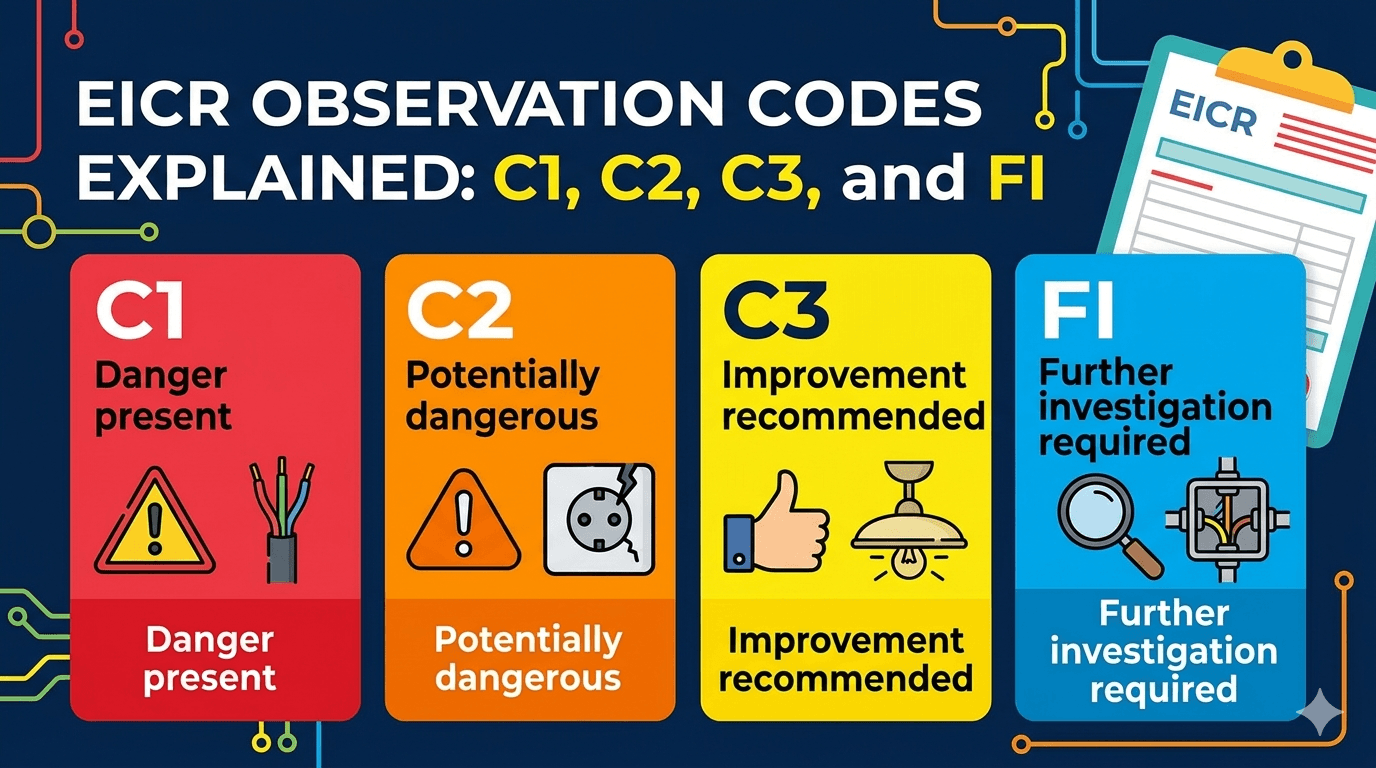
EICR Observation Codes Explained: C1, C2, C3, and FI
A plain-English guide to EICR classification codes under BS 7671. What each code means, when to use them, and how they affect your certificate outcome.
The RAMS Approval Process: A Guide for UK Contractors
The RAMS approval process for UK fire and electrical contractors: what the law asks, what clients ask, version control, engineer sign-off and approval.
Fire Alarm Servicing Under BS 5839-1:2025: What Changed
How often a fire alarm should be serviced under BS 5839-1:2025, what every visit should now cover, and what the 2025 revision changed for service engineers.